

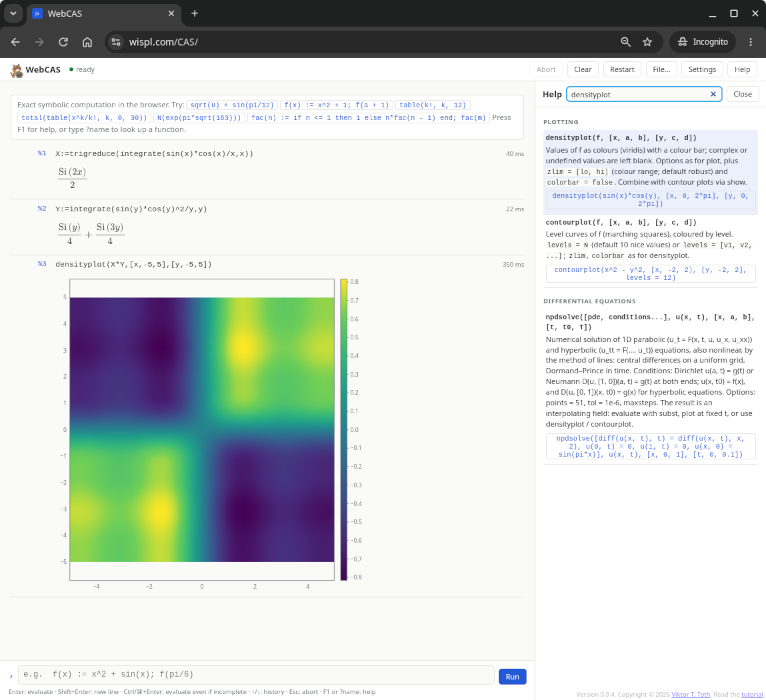
 This is something I wanted to do for a long time: a computer algebra system (CAS), perhaps not as capable as leading models such as our Maxima, but one that is nonetheless useful.
With the help of large language models, this project turned from wishful thinking into reality. In a matter of days, with the help of the latest Claude 5.5 Opus model, I managed to create an application with over 33,000 lines of source code, implementing all the core features of a comprehensive CAS, including even, e.g., advanced integration algorithms.
I use the first person intentionally, even though most of the code lines were delivered by Claude. Claude was not used in this case as an independent coding agent. Rather, the AI was invoked as a mere chatbot, through my own chat interface at WISPL, acting in the role of a capable assistant. This ensured that I remained part of the loop, so to speak, individually receiving, and incorporating into the code base, specific solutions as the application was constructed incrementally and interactively. Claude brought enormous depth and breadth to the table, but I retained agency: the development of the application followed my directions and priorities, and I was ultimately responsible for putting everything together.
The result, I think, speaks for itself: free to try, since it only uses computational resources on the user's computer. My server simply delivers the JavaScript files, that's all.
