

Who I am
I am a software developer and author of computer books. I also work on some problems in theoretical physics. This is my personal Web site where I publish information about:
My professional experience
I received my first software development contract in 1979: My task was to simulate the take-off distance of TU-154 aircraft with engine failure at Budapest airport under various weather conditions, to compute tables of maximum take-off weight. Since then, I worked on many software projects and I am thoroughly familiar with the entire software development life cycle. I authored or co-authored studies for large software projects: For instance, I was one of the authors of the $65M Automation Master Plan of the Canadian Patent Office in 1988. I designed and developed the Windows version of Industry Canada's Integrated Spectrum Observation Centre, with over 120,000 lines of C++ code. I created NORTEC's HELP (Humidification, Engineering and Loadsizing Program), an application for professional engineers and salespersons dealing with large-scale building humidification systems. I also wrote several books on the C++ programming language and the Linux operating system. As part of my scientific research, I independently developed a precision orbit determination program used to analyze the anomalous trajectory of the Pioneer 10 and 11 spacecraft. More recently, I worked under contract with NASA JPL on the Solar Gravitational Lens, investigating the possibility of using gravitational lensing by the Sun to image distant targets, including possible life-bearing exoplanets. I am also one of the maintainers of Maxima, the preeminent open source computer algebra system.
I am just as competent with modern software development technologies as with ancient systems. I routinely switch between developing an interactive app for my Android smartphone and maintaining 50-year old legacy LISP code for Maxima. I am familiar with formal software project management and development methodologies. Last but not least, I also have experience designing and debugging hardware.
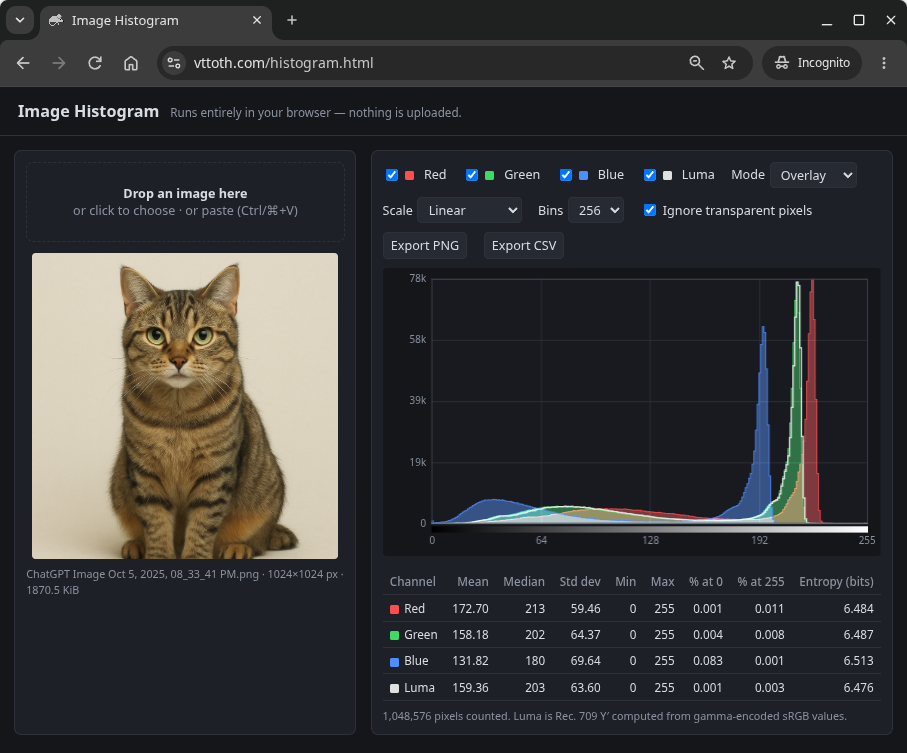
Chatting with a friend of mine, a photography buff, he mentioned how useful he finds it that one of his cameras offers a histogram feature. Since we were talking about AI models earlier in the same conversation, this looked like a perfect opportunity to demonstrate what language models can do in late 2026. While we were talking, I sent this prompt to Claude 5.5 Opus: "Create for me a self-contained Web application, preferably in the form of a single index.html file, to which I can upload an image, and it generates a histogram." That was it. That was all. No elaboration, no detailed "contract", just a simple request.
The result, I think, speaks for itself.
Two cannons, aimed at each other and firing at approximately the same time, will result in a mid-air collision, regardless of the weight of the cannonballs or the speed at which they are fired. (Ignoring air resistance.) This is a neat little simulation, created by Claude, demonstrating this. Click the link in the title for some background.
A very nice Claude implementation of Conway's Game of Life, modified with a stochasticity parameter added.

